
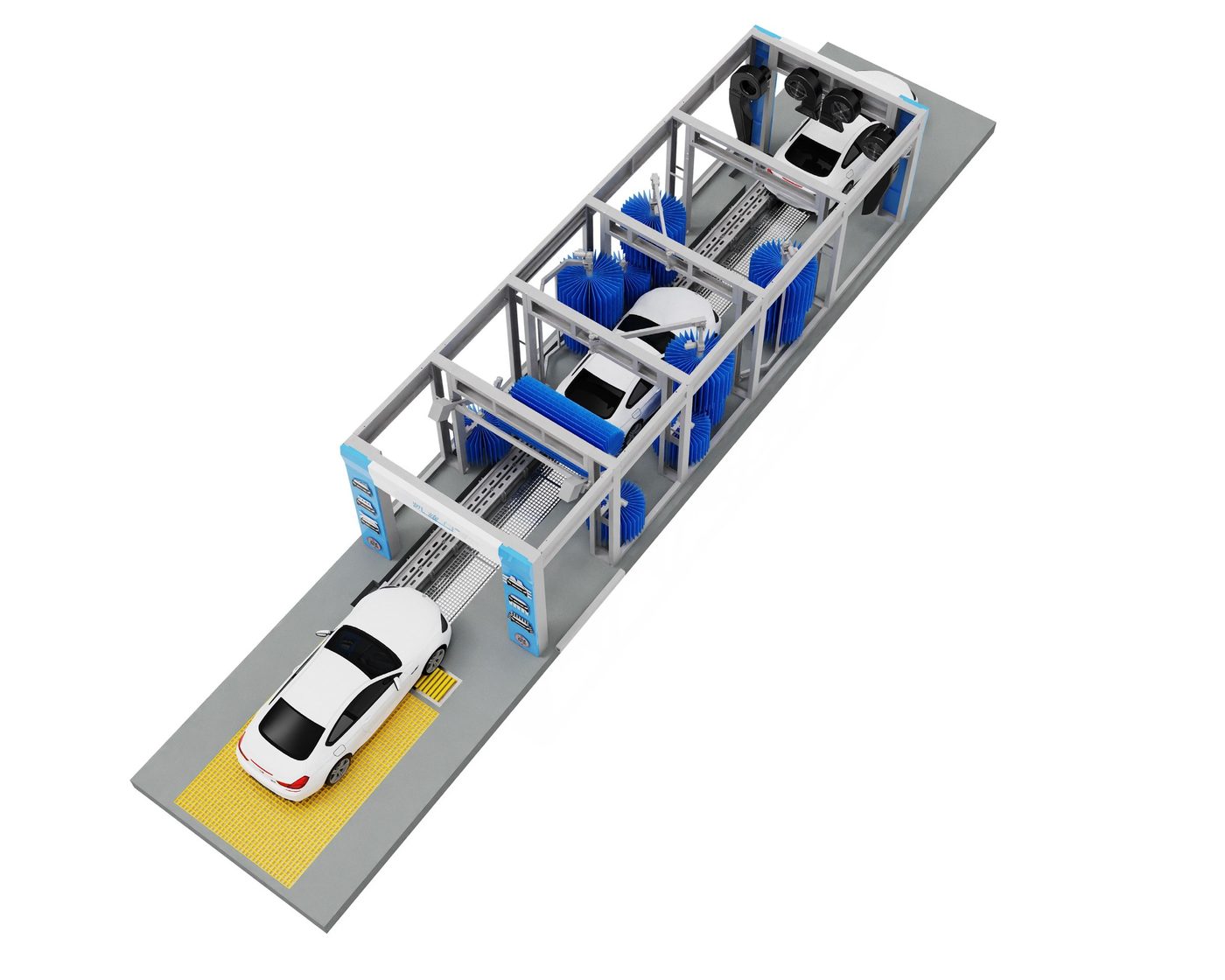
When gas-station investors add a car wash, some choose a rollover machine — with brushes or brushless. Sometimes that choice comes down to the site: a dead-end corner where a car cannot drive out forward after the wash. Sometimes it comes down to money: a rollover costs much less to install.
But choosing a rollover quietly puts a ceiling on how many cars your station can wash in a day — and on what your business can become. A rollover washes roughly 150–200 cars a day, about 15–20 an hour.
In terms of footprint, the two are not far apart. A rollover needs at least 4 metres wide, 9 metres long and 3 metres high of clear space. A small tunnel system fits in about the same space. But the throughput and the traffic it brings are a different story.
A rollover washes one car at a time — the next car can only enter once the previous one has left. A tunnel washes continuously, one car after another. Put simply: a rollover takes about 3 minutes per car, while in those same 3 minutes, 3–4 cars can drive out of a tunnel.
Waiting is the part drivers hate most
For a driver who has just fuelled up and is waiting to wash, waiting is hard — especially under a blazing sun. If you can cut that wait, even a little, the customer experience improves a lot. With a rollover, a driver has to wait the full 3 minutes before entering. With a tunnel, the wait is around 40 seconds. That feels very different.
“We only wash a hundred a day” is the wrong maths
Some investors tell us they only wash a little over a hundred cars a day, so one rollover is enough. That estimate is very inaccurate — and unwise. A gas station is a passive business: you cannot know when the traffic will come or how much of it there will be. Traffic through the month is far from even. Weekdays may be quiet, but on holidays cars can arrive in a rush and hit a peak in a very short time.
Free wash with fuel is mainly about those peak moments. A station has to meet a sudden surge of wash demand in as little time as possible. That is why you see large stations running two, three or more wash machines — I once saw a station in southern China running seven tunnel machines. At quiet times one machine would be enough, but who wants to watch a sudden surge of traffic drive into the station next door?
In an earlier article about car wash sites in Europe and America, we saw that most wash sites have 3–4 payment lanes and two tunnel machines side by side — mainly to handle sudden surges, cut waiting time and keep customers happy. It is like a highway toll plaza: even on a quiet stretch of road there are 2–3 lanes. When it is quiet, a cone blocks all but one; when it is busy, they all open.
A tunnel is also easier to keep running
On the machine itself, a tunnel is far easier to maintain and far less prone to breakdowns than a rollover. A rollover packs every function into a relatively small body, so it uses many sensors, and there is little room to work in. Without real expertise, its faults are hard to fix. A tunnel is an open design: its functions are spread across a larger space and connected by cables and hydraulic lines. It breaks down less often, there is room to work, and simple faults can usually be fixed with a technician’s guidance over video — so downtime is shorter.
All in all, for a gas station investing in a wash business, a tunnel machine is the safer choice, and it can more easily meet the wash demand as your business grows. And if you already have a rollover and your wash demand is growing, switching to a tunnel is a good move.