
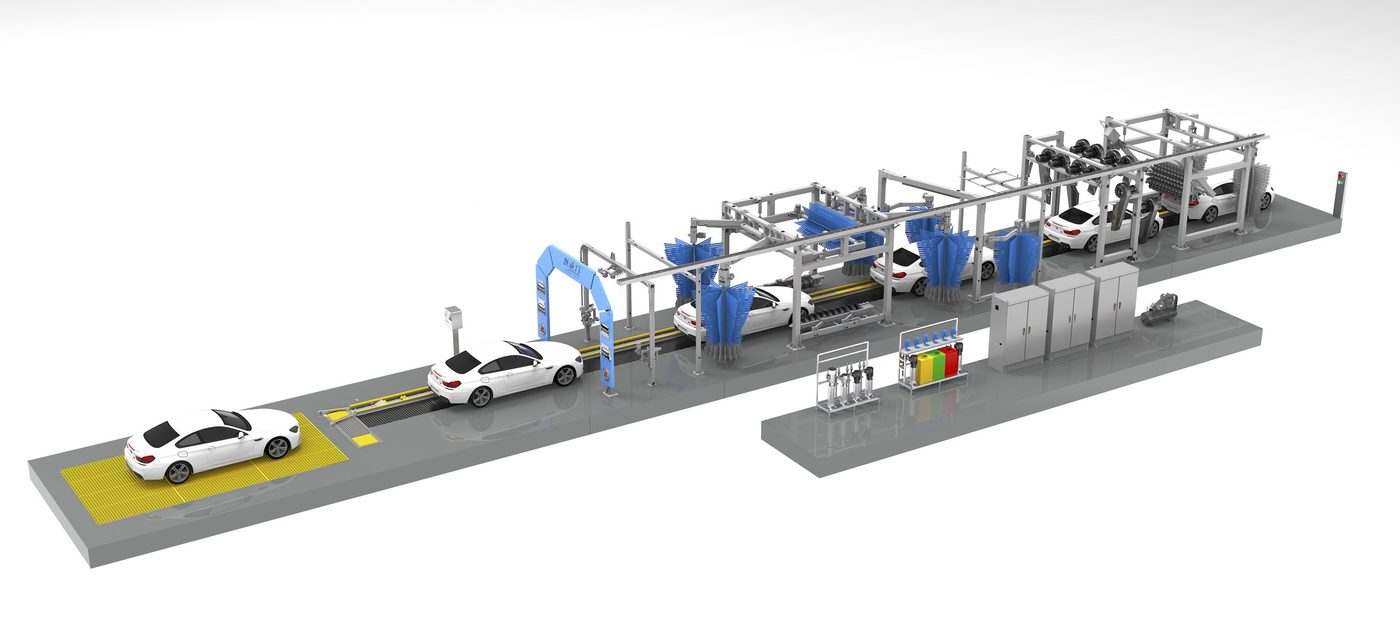
Today, the gas-station industry is the mainstream buyer of automatic car wash machines — the great majority of machines are installed at gas stations large and small. Differences in machine design decide how clean the wash is, how fast the brushes work, how safe the wash is, and what maintenance costs. With manufacturing as advanced as it is today, most sensors, gear motors and other parts are already very reliable, and software control is dependable too. So the “wash safety” we talk about here is a relative idea, not an absolute one. Today I want to focus on the brush section of the tunnel car wash machine — starting with the top brush.
Two designs: vertically operated and pivoting
The top brushes on today’s automatic car wash machines fall into two main designs: the vertically operated top brush and the pivoting top brush.
The earlier vertically operated top brush used a cylinder and a counterweight to control the lift. When the brush is washing, the car pushes back against it, swinging it forward at an angle. When the first proximity sensor detects that swing, the cylinder pulls the brush up. For safety, a second proximity sensor is fitted — so that if the swing angle gets too large, or the first sensor fails, the brush can still lift safely.
Some makers of vertically operated top brushes have now removed the swing angle altogether, and instead control the lift by detecting the change in the drive motor’s current as the brush turns. In theory this is more scientific, and safer: a fixed range of current controls how hard the brush presses against the car body. If the current goes above the range, the brush is pressing too hard and the PLC lifts it; if it goes below, the opposite happens. The brush stays in dynamic balance, so the cleaning force is even and stable, the lift is smooth, and there is none of the jerky feel of a cylinder lift.
The pivoting top brush is widely used in Europe, America and China — mainly because it is simple and reliable. In this design, a counterweight sits on the opposite side of the brush. When the brush is washing, the car’s push-back and the counterweight’s downward weight together drive the brush upward, and as the car moves forward, the brush cleans the whole contour from the hood to the trunk.
Pivoting top brushes come in two forms: the single-arm type, more popular in the United States, and the double-arm type, more popular in Europe and China.
The single-arm top brush is popular in the US mainly for its space-saving design and flexible installation. With vehicle recognition sensors, it can safely wash pickup trucks. And in high-speed washing at more than 150 cars an hour, the single-arm top brush is unmatched for safety.
The double-arm top brush is all about safety and simplicity. Its failure rate is extremely low, its later maintenance cost is almost zero, and its wash safety is very high — there is no wash accident caused by a sensor failure.
In car-detail shops that chase the highest cleanliness, both the vertically operated top brush and the pivoting top brush have a contour-following upgrade version.
The vertically operated top brush wins on precise control and even cleaning force. Its weakness is that it has many wear parts and does not suit fast washing — which is why, in the US market, where fast washing is demanded, you mostly see pivoting top brushes. Even WashTec’s US subsidiary MARK7 uses pivoting top brushes.
Today’s top brush technology is mature in every form, and whichever approach is used, safety is high.
In China, though, the wash industry badly lacks maintenance technicians and professionals. Most people working at wash sites cannot solve complex circuit and software problems, so a vertically operated top brush costs far more to maintain than a pivoting top brush.
China’s wash industry is much like America’s: high wash speed, very large daily volume, and the same shortage of professional technicians. That is why pivoting top brushes are so widespread in China.
So, for gas stations — the main buyers of automatic car wash machines — our view is this: if you want precise cleaning force, choose a vertically operated top brush, but be ready for higher maintenance costs and some safety risk. If you want high-speed, safe washing with low maintenance costs, choose a pivoting top brush.