
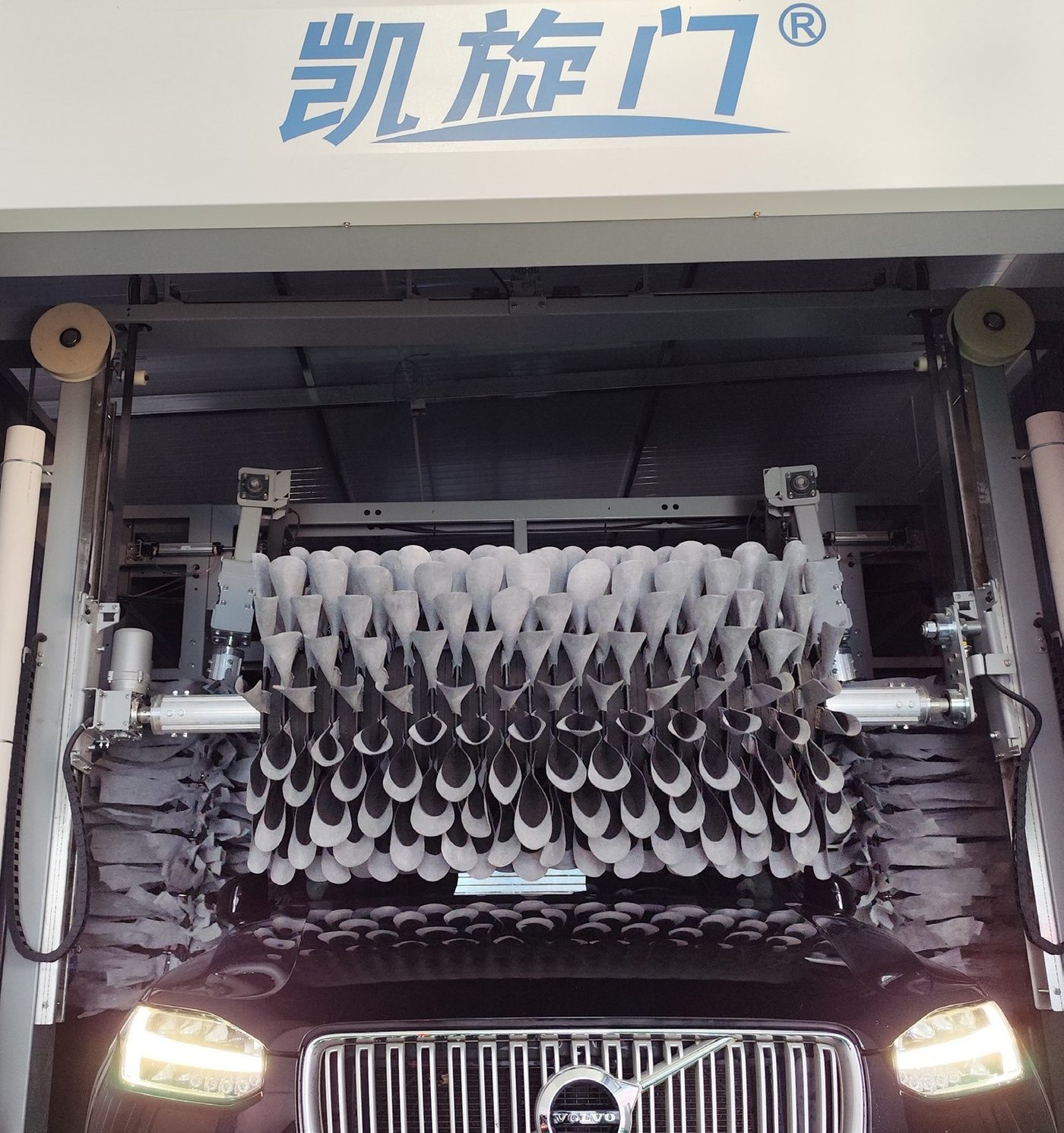
We have said before that the next stage of competition between automatic car wash machines will be drying technology. Drying is the last stage of the wash, and how well it works stands for the level of the whole wash system — and so decides how customers judge the machine.
Drying is a comprehensive technology. It touches the wash function, wash chemistry, the blower system, the drying materials and the layout of the machine. In this article, let us talk about how to improve the drying stage of an automatic car wash machine.
Start improving at the entrance
We know that a car surface that has not been cleaned thoroughly cannot be dried properly. So from the moment a car enters the machine, the first job is to wet the surface and spray a mildly alkaline detergent, to remove organic matter — insect residue, tree sap, grease, bird droppings and the like. Bug residue on the front of the car needs a somewhat stronger alkaline liquid.
Tap water and well water are both mildly alkaline, so after the first spray of mildly alkaline detergent and a rinse, the car surface is mildly alkaline. By chemical action, some of the dirt that has been soaked loose still stays stuck to the paint. The glass and the chrome trim cannot be cleaned at this stage either — they need a mildly acidic detergent before they are truly clean.
So in the brush stage we still need to spray detergent — but now a mildly acidic one. Besides removing oxides from the paint and cleaning the glass and chrome, a mildly acidic detergent removes the dirt that was held on the paint by the alkaline stage. At the same time, the leftover alkaline detergent is neutralised, and the surface pH becomes neutral or mildly acidic.
Improving the final rinse
Once the car is clean, it goes into the final rinse. Here, one job is to rinse off the leftover detergent, foam and dirt. The other is to spray a drying agent — commonly called a water repellent or drying wax — to help the surface shed water. A good-quality drying agent at the right concentration breaks the surface tension of the sheet of water on the body, gathering it into scattered droplets — the lotus-leaf effect, where water beads and rolls off.
Too high a concentration brings new problems: excess drying agent can leave white spots or white patches on the body. So always consult the drying agent supplier and test it yourself before settling the concentration.
The rinse spray should keep misting as low as possible. Mist drifts around inside the machine, gets sucked into the blower and blown back onto the car — badly hurting the drying result.
Two ways to improve this: first, increase the water flow and lower the pressure. Change the multi-nozzle spray to a multi-hole manifold, so the rinse water falls as a water curtain. Because the water hits the car surface with less force, misting falls sharply. Second, add physical barriers to stop the mist spreading — or isolate the blower air intake from the mist entirely, so the blower only blows dry air.
Improving the blower stage
First, place the right number of blowers and choose blowers whose air flow and air speed match the job. Here we have to talk about cost and return. With the right blower chosen, more blowers certainly dry better — but they also use more power. To reach an ideal drying result, how much electricity per car is reasonable? We know that removing 95% of the water is easy; the hard part is the last 5%.
The usual blower layout in China is four blowers on top and one on each side. What I would say is that customers can try different blower layouts and positions. Sometimes moving a blower just a little changes the drying result a lot.
In Europe and America, a layout is gradually catching on: about a metre or so after the rinse, one high-speed blower on top, to break the water off the surface — and at the same time to stir the drying agent and the rinse water together more thoroughly, raising drying efficiency.
Add a brush dryer system
Even after a thorough wash, a good drying agent in the rinse and a blower stage that has removed most of the water, some droplets still remain on the body.
A brush dryer absorbs most of the remaining droplets. At the same time, it spreads the brightening agent in the drying wax evenly over the body and, through high-speed rotation, smooths out the tiny pits left in the paint after oxides were removed in the wash — making the paint flatter and more reflective. Think of polishing shoes: the faster the hand, the brighter the shoe. That is also the secret of why a waxed car shines more.
With that, you have a car wash line with outstanding results.